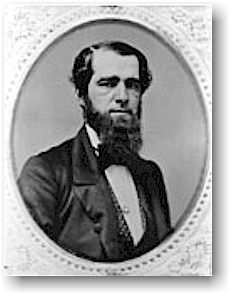
O.K. This is one great story: brace yourself. Jingle Bells is not a Christmas song.
Written by James Pierpont in 1857, and republished in 1859, it memorializes the 'cutter' drag races in Boston, where spiffed out sleighs would race between Medford and Malden Squares, and the drivers would try to pick up the local chicks.
Young James was a rogue; he abandoned his family several times, took up arms for the Confederacy (his father was a Boston Abolitionist minister), and, after his first wife died, he abandoned his children to take another wife, who may or may not have already been pregnant with Pierpont's child. He was living the fast times in the horse and buggy days, but if you really look hard, you'll see that rock-and-roll was out there, even before it had a beat.
Here's the original
lyrics:
Dashing thro' the
snow,
In a one-horse open sleigh,
O'er the hills we go,
Laughing all the way;
Bells on bob tail ring,
Making spirits bright,
Oh what sport to ride and sing
A sleighing song to night.
Chorus:
Jingle bells, Jingle bells,
Jingle all the way;
Oh! what joy it is to ride
In a one horse open sleigh.
Jingle bells, Jingle bells,
Jingle all the way;
Oh! what joy it is to ride
In a one horse open sleigh.
A day or two ago,
I thought I'd take a ride,
And soon Miss Fannie Bright
Was seated by my side,
The horse was lean and lank;
Misfortune seemed his lot,
He got into a drifted bank,
And we, we got upsot.
Chorus A day or two ago,
The story I must tell
I went out on the snow
And on my back I fell;
A gent was riding by
In a one-horse open sleigh,
He laughed as there I sprawling lie,
But quickly drove away.
Chorus Now the ground is
white
Go it while you're young,
Take the girls to night
And sing this sleighing song;
Just get a bob tailed bay
Two forty as his speed.
Hitch him to an open sleigh
And crack, you'll take the lead.
James Lord Pierpont once belonged to that elite, fighting equestrian unit known as The Fifth Georgia Cavalry. He served in Company H, well known to Northern adversaries as "The Lamar Rangers." Since his compiled service records list him as "a company clerk," it is doubtful that he experienced a substantial amount of combat. But, Private Pierpont was not "your prototypical Confederate Horse Soldier;" being a native of New England (Massachusetts), he was the son of a radical abolitionist, who was also a poet and a Unitarian Minister. During "That War Of The Rebellion," Pastor John Pierpont served as Chaplain of The 22nd Massachusetts Regiment. At the time, he was 76 years of age.
Born in Boston, Massachusetts in 1822, James Pierpont moved to Savannah Georgia circa 1853. His older brother, John Pierpont, Jr., had accepted a pastoral post with The Savannah, Georgia Unitarian Congregation. Young James accompanied his brother as the organist / music director for The Church.
Following the death of his first wife ( in the mid 1850's from that malady known as tuberculosis), James married a local girl, who just happened to be the daughter of Savannah Mayor Thomas Purse. Hence, his roots were now deeply embedded in Savannah's Southern soil!
By the time the decade of the 1860's rolled around, The Unitarian Church of Savannah, Georgia had ceased to exist. Of course, this was directly related to its radical abolitionist leanings and inclinations -- which weren't incredibly popular down South in Savannah, Georgia during those final Ante-Bellum years. As one might readily expect, Reverend John Pierpont, Jr. packed his bags and headed "Due North." His younger brother, James, remained in Savannah. In April of 1862, James joined an outfit known as "The Isle of Hope Volunteers." Subsequently, as alluded to earlier, this unit would be designated as "Company H of The Fifth Georgia Cavalry."
In 1857, James wrote a jingle called ONE HORSE OPEN SLEIGH. A couple of years later, he changed the name of the composition to JINGLE BELLS. Initially, in 1859, it wasn't a Christmas Carol. For decades, it remained little more than an obscure sleighing song.
By the time James L. Pierpont passed away in 1893, JINGLE BELLS had generated precious few royalties. It did not become a popular Christmas Carol until the days of radio broadcasts and phonograph records.
Although James died in Winter Haven, Florida, he is interred in Laurel Grove Cemetery in Savannah. He lies in a state of eternal rest beside his brother-in-law, Thomas Purse, who was killed in action at First Manassas.
James Pierpont also wrote and composed numerous other tunes; during the four years of hostilities between North and South, he further exhibited his Southern Patriotism by composing music for His Beloved Confederacy. Such pseudo-anthems as OUR BATTLE FLAG, STRIKE FOR THE SOUTH, AND WE CONQUER OR DIE are musical creations penned by Private Pierpont. It has been written that James Pierpont embraced and supported The Southern Confederacy because he viewed the anti-slavery stance held by many Northerners (New Englanders, in particular) to be a prime example of HYPOCRISY! It was certainly no secret that many had become quite opulent as a result of "That Peculiar Institution." Having said this, it is quite simple to ascertain why many New Englanders (who were familiar with The Pierpont Family) considered James Pierpont to be a rebellious musician with a bad reputation! One Massachusetts Mayor even referred to him as "a bit of a rogue!"
In closing, "is JINGLE BELLS a Rebel Tune?" You bet it is!
Daughtry, Hu. Published in the December, 2008 edition of the Dispatch, Newsletter of the Dixie Guards SCV, Metter, GA. Used by permission.